Pet beds are one of the most returned categories in pet supply retail, and most returns trace back to two avoidable mistakes: a size that does not match the animal, and a filling that collapses within weeks. The questions below are the ones buyers ask most often during sampling, and the answers are written so they can be applied directly to a specification sheet or a purchase order.
How do I choose the right bed size by the pet's weight?
Weight alone is a starting filter, not a final answer, because body length matters more than the number on the scale for long-backed breeds. Use the weight band to pick the general bracket, then confirm with a length measurement taken from the base of the tail to the front of the chest. As a working rule, the bed's inner sleep surface should be at least 1.2 times the pet's body length so the animal can stretch out rather than curl into a ball on a pad that is too short.
For B2B assortment planning, stock three bands rather than eight. A small band covering roughly 5 to 12 kg, a medium band around 12 to 25 kg, and a large band from 25 to 45 kg will cover the majority of household dogs and cats without splitting demand too thinly across SKUs.
What is the real difference between memory foam and ordinary cotton filling?
Memory foam is a viscoelastic polyurethane that distributes pressure and slowly returns to shape; ordinary cotton or polyester fibre recovers quickly but compresses permanently under constant load. For older animals, large breeds, or any pet that spends more than twelve hours a day resting, a foam base holds its loft for years instead of months, which is the difference customers notice first.
A practical construction is a layered base: a 5 to 8 cm high-density foam core for support, topped with a softer comfort layer, and wrapped in a quilted outer shell. Pure memory foam on its own feels firm and traps heat, so pairing it with a breathable topper is usually a better product than a thicker slab of foam.
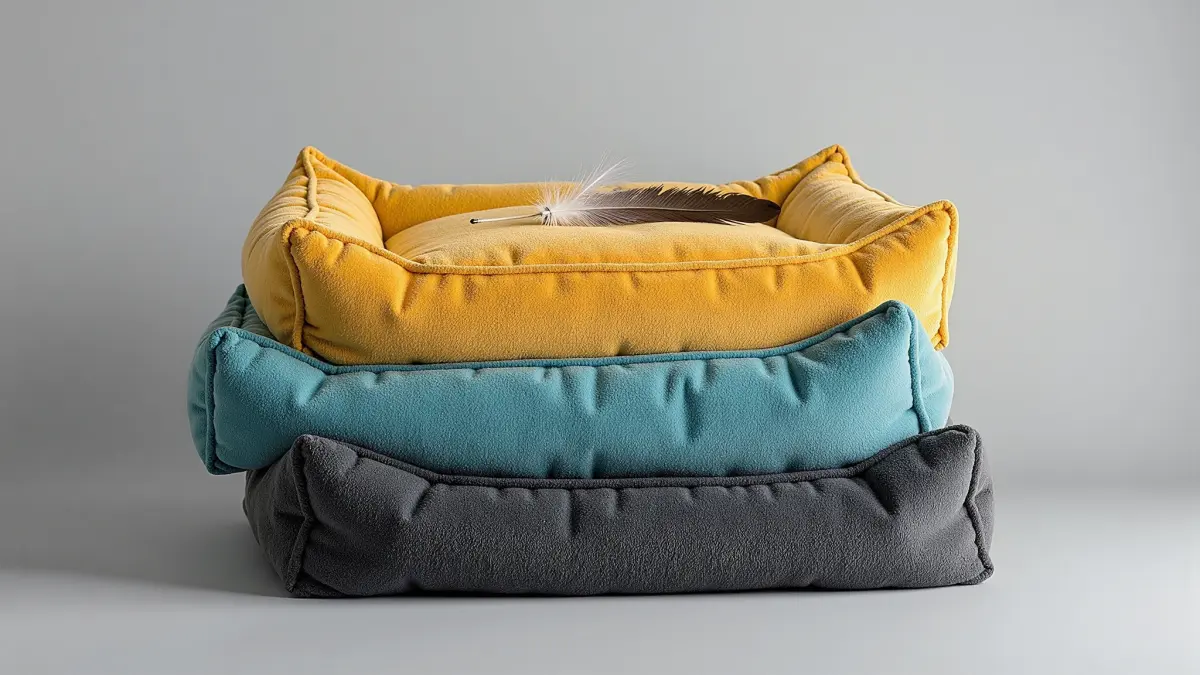
Does a removable, washable cover really matter?
Yes, and it is often the deciding factor in repeat purchase. Odour, hair and saliva accumulate in the cover long before the filling fails, so a cover that unzips and goes into a domestic washing machine at 30 degrees extends the usable life of the whole product. Specify a hidden zip with a fabric guard so the pet cannot chew or catch a claw on the teeth, and confirm the cover still fits after five wash cycles in testing.
For buyers, the commercial benefit is straightforward: washable covers reduce warranty complaints and let you market one bed for both indoor and crate use. Include washing instructions on a sewn-in label rather than only on the retail carton.
How should an anti-slip base be built?
Anti-slip performance comes from the underside, not the top. A dotted PVC or TPR grip pattern on the base panel gives reliable traction on tile and laminate while staying soft enough not to scratch hardwood. Stitch the base panel fully around the perimeter and add a reinforcing tape at the seams, because a base that peels at one corner is the most common failure point in the field.
If the bed will be used in cars or on smooth floors, ask the factory for a grip density specification and a simple friction test result. A base that shifts when a 20 kg dog steps in will be reported as a defect even when the filling is correct.
Which materials keep a bed breathable in summer?
Breathability is a function of airflow through the cover and the filling, so an open-weave canvas, linen blend or 3D mesh side panel will always outperform a tight plush. For warm climates, offer a reversible design with a cooling mesh side and a plush side for cooler months, which gives retailers a single SKU with a longer selling season.
Avoid solid waterproof membranes on the sleeping surface unless they are combined with a ventilated layer, since trapped heat is a frequent complaint in southern and coastal markets. Breathable, water-resistant fabrics are the better compromise for outdoor and balcony use.

How can a buyer test support before placing a bulk order?
Run three quick checks on every sample. First, press the centre of the bed with an open palm and release; the surface should return within two to three seconds without leaving a permanent dent. Second, place a 15 kg weight on the middle for one hour and measure the compression; more than 20 percent loss suggests the foam density is too low for the claimed size band. Third, unzip the cover and inspect the stitching, the zip guard and the foam edges for loose fibre or glue lines.
Record these results against the factory's stated specification and keep the sample as a golden reference for the production run. Documented sample testing is the cheapest quality control a buyer has, and it turns a subjective feel test into a repeatable acceptance criterion.